Indian Navy Commissions Indigenously Built Stealth Frigate INS Taragiri With Advanced Weapon Systems


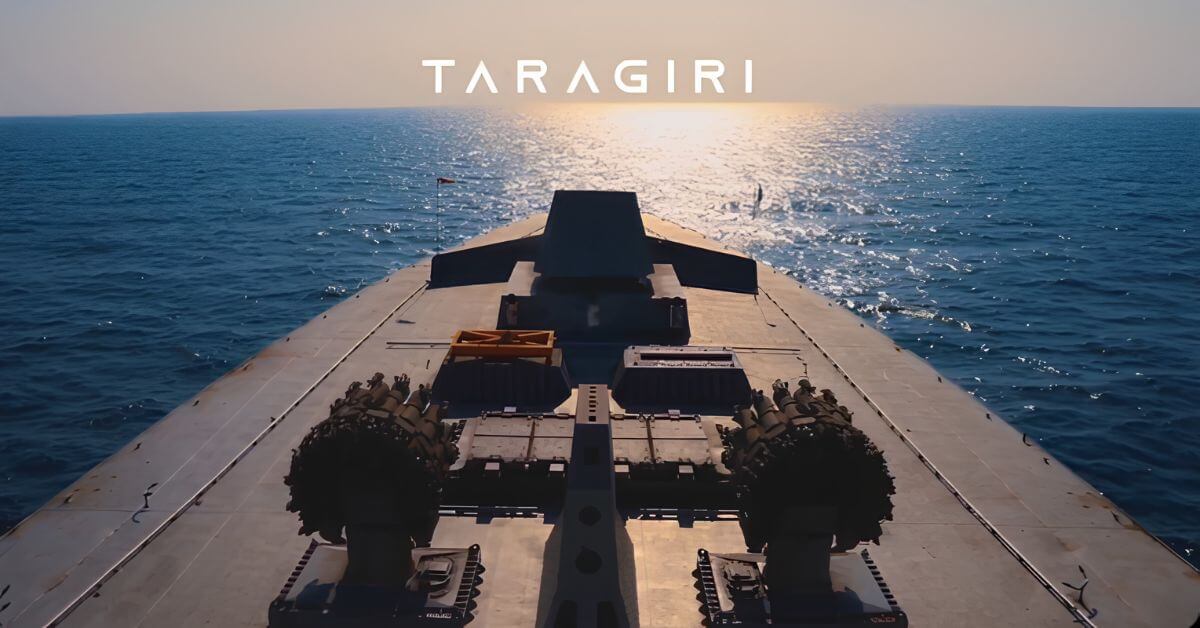
India commissioned the stealth frigate INS Taragiri into the Indian Navy on April 3 at Visakhapatnam. Defence Minister Rajnath Singh presided over the ceremony at the naval dockyard, alongside senior naval officials.
INS Taragiri is the fourth warship under Project 17A and has been built by Mazagon Dock Shipbuilders Limited in Mumbai.
The 6,670-tonne frigate was constructed with more than 75 per cent indigenous content, involving over 200 MSMEs across the country. It was delivered to the Navy in November 2025 after its keel was laid in September 2020.
Speaking at the event, Singh said the induction of Taragiri shows India’s growing strength at sea. He noted that a strong Navy is essential for the country, given its long coastline and dependence on sea routes for trade and energy security.
India has a coastline of over 11,000 kilometres, with nearly 95 per cent of its trade carried through maritime routes. The defence minister stated that maritime power will play a crucial role in achieving the country’s long-term economic goals.
He also said the Navy continues to maintain a steady presence from the Persian Gulf to the Malacca Strait and plays a key role during evacuation and humanitarian operations.
Legacy Reborn. Power Redefined.
Presenting the story of INS Taragiri – a journey of strength, stealth and indigenous excellence, reflecting India’s rise as a formidable maritime power.
From legacy to the future fleet, Taragiri stands ready to safeguard the seas.… pic.twitter.com/T8bigXfQkD
— SpokespersonNavy (@indiannavy) April 3, 2026
The warship has been designed with a reduced radar cross-section, making it harder to detect. It is powered by a Combined Diesel or Gas (CODOG) propulsion system, allowing it to operate at high speed as well as sustain long-duration missions.
INS Taragiri is equipped with a range of weapons, including supersonic surface-to-surface missiles, medium-range surface-to-air missiles, and systems for anti-submarine warfare.
It also carries a combat management system that connects its sensors and weapons, helping the crew respond quickly to different threats. An Integrated Platform Management System controls and monitors the ship’s machinery and power systems.
Apart from combat roles, the frigate is also built to handle humanitarian assistance, disaster relief and evacuation missions, which the Navy often undertakes in crisis situations.
Commanding Officer Captain Hemanth Gopal said that while building the ship is the job of the shipyard, it is the crew’s responsibility to make sure all systems work together and turn it into a functioning warship.
Officers onboard said that even though ships of the same class are built in a similar way, each one develops its own identity based on the people who operate it.
They added that the earlier INS Taragiri, which served from 1980 to 2013, was known for completing its missions reliably, and the new crew aims to carry forward that record.
The use of indigenous equipment on the ship is also expected to make maintenance easier, as spare parts and servicing can be managed within the country instead of depending on foreign suppliers.
INS Taragiri is designed for multi-role operations at sea and is expected to support the Navy’s expanding role across the Indo-Pacific region.
References: Money Control, newindianexpress
Want to read more?
Check out the full article on the original site